
The emergence of intelligent devices is changing the way we live and work. With the advent of autonomous vehicles and smart factories, there’s an increasing need for real-time insights and quick decision-making, fueling the growth of edge AI. This cutting-edge approach to artificial intelligence delivers processing capabilities closer to the data source, creating new product design and development opportunities. In this post, we’ll delve into edge AI, its functioning, key advantages, its impact across various industries, and how Suntsu can empower your edge AI implementations.
What is Edge AI?
Edge AI vs. Cloud AI
Cloud AI utilizes powerful servers located in distant data centers to handle data processing and execute AI algorithms. Although it provides substantial computing power and scalability, Cloud AI comes with some drawbacks. Data must be sent to the cloud, which can lead to increased latency, higher bandwidth consumption, and potential privacy issues. Cloud AI is especially effective for tasks demanding significant computational resources that are not time-sensitive.
Conversely, edge AI tackles these challenges by processing data locally. This approach reduces latency, minimizes bandwidth use, and improves privacy, making it well-suited for applications that require immediate decision-making, such as autonomous vehicles, industrial automation, and personalized healthcare. Ultimately, the decision between edge AI and cloud AI depends on the specific needs of the application.
Feature Edge AI Cloud AI Location On-device, near the data source Centralized servers Latency Low High Connectivity Less dependent Highly dependent Privacy Enhanced Potentially less secure Processing Power Limited by device capabilities High Scalability Limited by number of devices High
While edge AI and cloud AI might seem like competing technologies, they are often complementary. Cloud AI can be used for training complex models and managing large datasets, while edge AI can be used for deploying and running these models on devices for real-time inference.
Benefits of Edge AI in User Products
Edge AI is rapidly transforming user experiences by bringing intelligence directly to devices, resulting in a host of advantages, such as:
How Suntsu Can Help with Edge AI Applications
Edge AI deployments often require specialized hardware to maximize efficiency and performance. While CPUs and MCUs can handle some edge AI tasks, they may encounter limitations when dealing with complex models or demanding real-time processing. This is where dedicated Neural Processing Units (NPUs), such as edge AI chips, become essential. These chips are designed specifically for AI workloads, offering optimized performance and power efficiency. They work in conjunction with CPUs and MCUs, handling the computationally intensive AI tasks, while the CPU/MCU manages other device functions.
Suntsu Electronics understands the diverse hardware needs of edge AI applications. We partner with leading manufacturers like AONDevices, a company at the forefront of edge AI chip technology, to provide our customers with access to cutting-edge solutions. AONDevices’ AON1100, for example, is a powerful AI chip designed to accelerate edge AI processing. This chip can acquire data directly from sensors, perform complex analysis using its integrated AI platform, and then seamlessly transmit the results to an MCU for further action. This type of integrated solution is crucial for applications requiring low latency and efficient data handling.
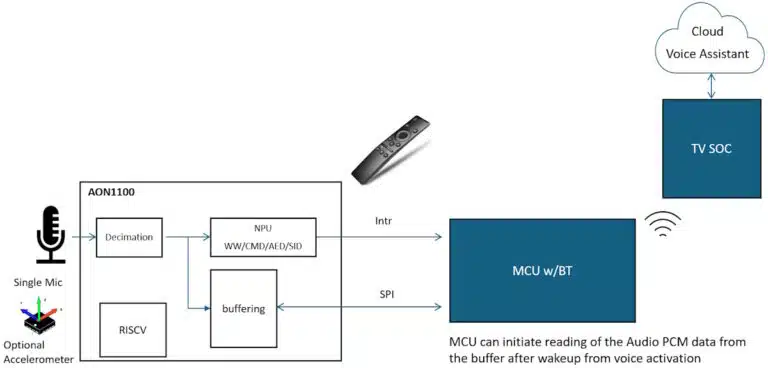
AONDevices’ technology is being implemented in innovative solutions such as always-on remote controls that offer intuitive user experiences and revolutionary sensor modules that enhance data analysis at the edge. These advancements, powered by edge AI chips, are enabling new levels of interactivity and intelligence in a wide range of devices.
Benefits at a Glance
- Single Microphone Design: Reduces power consumption and BOM costs while maintaining high performance.
- Ultra-Low-Power Consumption: Extends battery life for fewer replacements.
- Energy Harvesting: Recharges using ambient light or RF signals, reducing dependency on traditional batteries.
- Customizable AI Features: Tailored wake words, local commands, and speaker identification ensure a personalized user experience.
- Privacy: All audio processing occurs locally, and no ambient audio data is communicated outside the remote.
Edge AI in Action: Real-World Applications Across Industries
Edge AI is making a significant impact across numerous products and sectors, driving innovation and delivering benefits to both users and businesses. Some examples include:

Smartphones
Features like facial recognition, advanced image processing, and voice assistants rely on Edge AI technology.

Smart Homes
Devices such as smart speakers, thermostats, and security cameras utilize edge AI to handle voice commands, interpret sensor data, and identify anomalies locally.

Wearables
Fitness trackers and smartwatches leverage edge AI to monitor and analyze health data in real-time.

Automotive
Autonomous vehicles depend on edge AI for navigation, object detection, and driver assistance features.
Manufacturing
Edge AI enhances predictive maintenance and quality control through immediate data analysis.

Healthcare
Solutions for remote patient monitoring and diagnostic assistance benefit from the local data processing capabilities of edge AI.

Retail
Personalized suggestions and streamlined inventory management are enriched by edge AI’s capacity for real-time insights.
The Future Outlook with Edge AI Capabilities
As processing power in edge devices continues to increase and AI models become more efficient, we can expect to see the emergence of even more sophisticated applications. Edge AI can potentially transform industries such as healthcare, transportation, and manufacturing, leading to safer, more efficient, and personalized experiences. We can anticipate advancements in several key areas:
- Enhanced AI capabilities on devices: More complex AI models will be able to run efficiently on edge devices.
- Improved privacy and security: Edge AI will play a crucial role in securing sensitive data.
- Increased autonomy: Devices will become more intelligent and capable of making independent decisions.
- Seamless integration: Edge AI will be seamlessly integrated into our daily lives, making technology more intuitive and helpful.
Edge AI is not merely a trend but a fundamental shift in our interaction with technology. At Suntsu Electronics, we recognize the importance of being at the forefront of this revolution. By offering high-quality electronic components and expert solutions, we empower our customers to create the next generation of edge AI-enabled devices, fostering innovation and shaping the future.
Suntsu Electronics can help you navigate the complex landscape of edge AI hardware. We offer a broad portfolio of components, including AI-optimized chips, sensors, connectivity solutions, and more, to support your edge AI development needs. Our team of experienced engineers can provide expert guidance to help you select the right components for your specific application, ensuring optimal performance, cost-effectiveness, and time-to-market. Contact us today to discuss your edge AI project and discover how Suntsu can be your trusted partner.