
In the realm of electronic components, precision and reliability are paramount. For over four decades, NIC Components Corp., in collaboration with Nippon Industries Co. Ltd., has been at the forefront of manufacturing and designing passive components. Their latest innovation, the NTRT Series Tantalum Nitride High Precision Thin Film Chip Resistors, is set to redefine industry standards. Let’s get into what makes this series stand out in the competitive landscape of passive components.

Tantalum Nitride (TaN) resistors are a testament to cutting-edge engineering. Unlike traditional Nickel Chromium (NiCr) thin film resistors, Tantalum Nitride resistors boast a moisture-resistant tantalum nitride resistive film. This unique feature provides unparalleled stability, especially in humid environments, making them a preferred choice for critical applications across various industries. The difference is measurable: under biased-humidity testing, passivated nichrome resistors can drift up to ±0.3%, whereas tantalum nitride typically shifts less than ±0.05% — and often under ±0.01% [1]. That order-of-magnitude improvement in long-term stability is what makes TaN the preferred film where drift over years of humid operation cannot be tolerated.
The manufacturing process involves sputtering tantalum nitride resistive elements in an inert nitrogen atmosphere, creating a protective oxide layer. This layer acts as a shield against moisture ingress, ensuring long-term stability and reliability—a crucial requirement in demanding environments such as aerospace, automotive, and medical equipment. The mechanism is self-correcting: where a nichrome film can break down within seconds when moisture and an applied voltage meet at the element, any moisture that reaches a tantalum nitride element immediately forms more of the same impervious tantalum-pentoxide barrier — the very compound used as the dielectric in tantalum capacitors [2]. The film effectively heals itself against humidity rather than degrading.
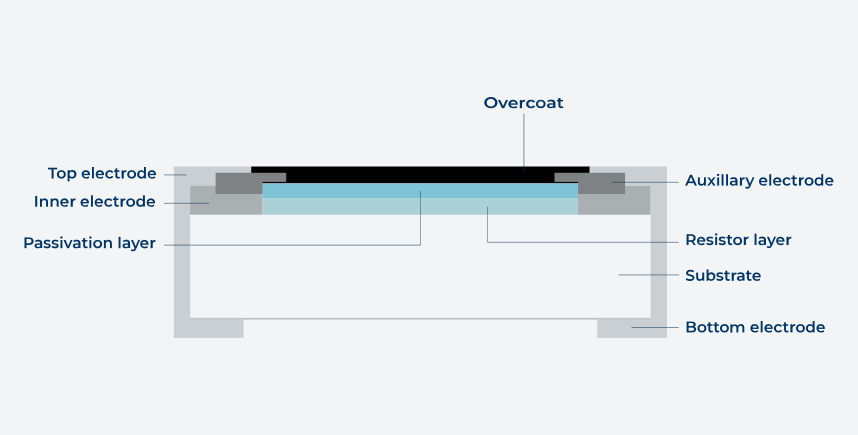
| Type | Std Thin Film Chip Resistors | TaN Thin Film Chip Resistors |
|---|---|---|
| Substrate | Alumina 96% | Alumina 96% |
| Resistor layer | NiCr | Tan |
| Passivation layer | - | TA₂O₅ |
| Inner electrode | - | Ag/Pd |
| Auxillary electrode | - | Yes |
The NTRT Series offers a range of features that set it apart from conventional thin film resistors. With resistance tolerances as low as +/- 0.05% and low-temperature coefficients down to +/- 10 ppm/°C, these resistors guarantee precise and consistent performance across a wide temperature range (-55°C to +155°C).
Moreover, the series covers package sizes from EIA 0402 to 1206, catering to diverse application requirements. Whether it’s aerospace, automotive, EV charging, industrial robotics, medical equipment, or test/measurement equipment, the NTRT Series delivers exceptional performance and reliability across various industries.
NIC Components understands the importance of environmental resilience in modern electronic components. The NTRT Series undergoes rigorous environmental testing to ensure robustness and longevity. From resistance temperature characteristics to moisture resistance and resistance to soldering heat, these resistors excel in every aspect.
Additionally, the series is compliant with RoHS3, China RoHS, and EU REACH regulations and boasts a Moisture Sensitivity Level (MSL) of 1, providing peace of mind regarding environmental compliance.
| No. | Environmental Test | NTRT Series |
|---|---|---|
| 1 | Resistance temperature characteristic | ±10ppm/°C |
| 2 | Maximum ambient temperature at rated wattage | +70°C |
| 3 | Maximum ambient temperature at power derating | +150°C |
| 4 | High-temperature exposure | ±0.15%(155℃) |
| 5 | Temperature Cycling |
±0.1%(125℃) ±0.2%(155℃) |
| 6 | Biased Humidity | ±0.1% |
| 7 | Operational Life | ±0.1% |
| 8 | Resistance to soldering heat | ±0.1% |
| 9 |
Moisture resistance (65±2°C, 80~100% RH, 10 cycles, 24 hours/ cycle) |
±0.1% |
| 10 | Short time overload | ± 0.1% |
| 11 | Sulfur Test |
±0.2% (ASTM-B809-95) |
As technology continues to evolve, the demand for precision passive components that can withstand harsh environments is on the rise. For systems expected to run for decades — military, aerospace, and long-life medical equipment — tantalum nitride is often the only film that stays within tolerance across that service life, which is why it has long been the default choice in those sectors [3]. NIC Components addresses this demand with its NTRT Series Tantalum Nitride High Precision Thin Film Chip Resistors. With superior moisture resistance, high stability in humid environments, and AEC-Q200 qualification, these resistors represent a leap forward in passive component technology. Whether it’s aerospace, automotive, or medical applications, the NTRT Series ensures reliability and performance, making it the go-to choice for engineers striving for excellence in their designs.
References
[1] Power Systems Design. “Precision Thin Film Resistors – Nichrome vs Tantalum Nitride: A Comparison” Available at: https://www.powersystemsdesign.com/articles/precision-thin-film-resistors-nichrome-vs-tantalum-nitride-a-comparison/39/20136
[2] Passive Components Blog. “Advances in Film Resistor Technology” Available at: https://passive-components.eu/advances-in-film-resistor-technology/
[3] Stackpole Electronics (via Mouser). “Nichrome × Tantalum Nitride: A Comparison” Available at: https://www.mouser.com/pdfDocs/20230818nichromextantalumnitride.pdf