
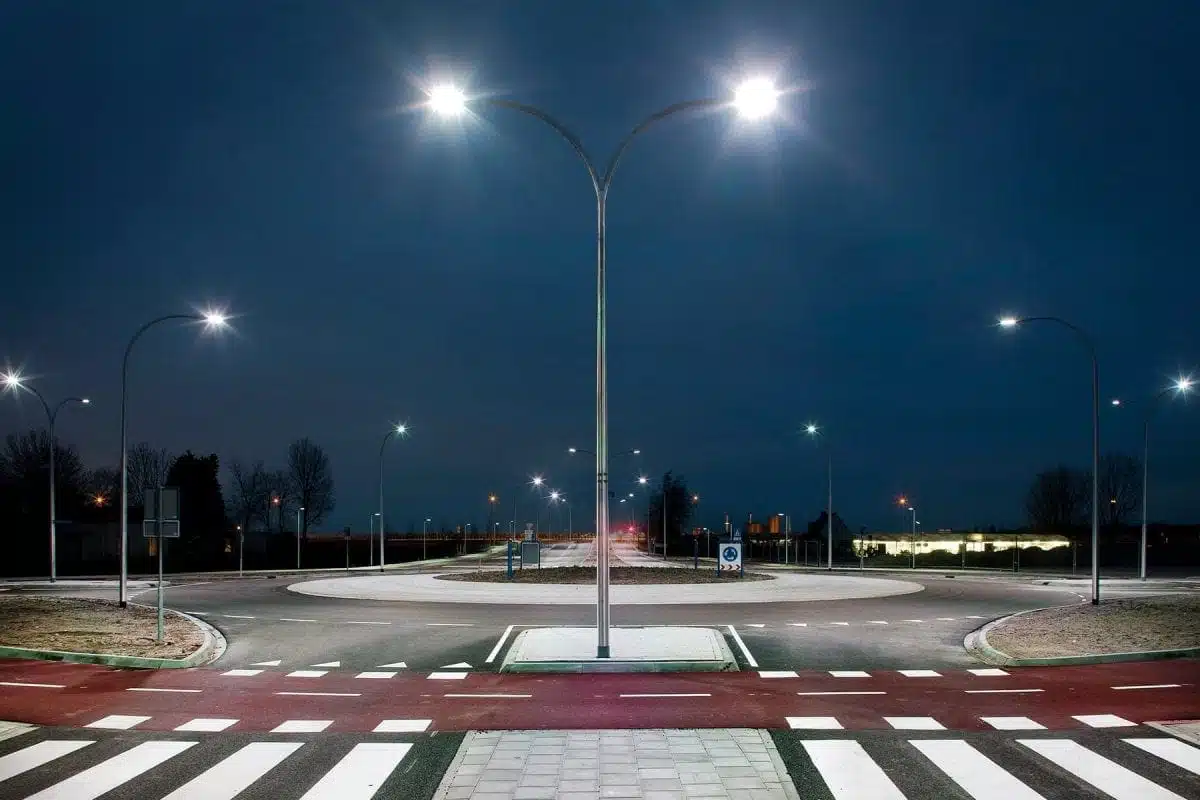
LED streetlights offer many advantages over conventional High Pressure Sodium (HPS) or Metal Halide options. Given that an LED can last 100,000 hours, the reduction in maintenance costs alone is one the biggest draws for municipalities [1].
Factor in the fact that LEDs produce about 80 lumens per watt as opposed to traditional streetlights at 58 lumens per watt, and the LEDs start making a lot of sense (and cents) [1]. It’s the kind of investment that pays for itself within the first few years of use.
LEDs also provide better light quality as measured by the Color Rendering Index (CRI). The light is brighter and since it’s more directional and less diffuse, LEDs offer more flexibility in their deployment. LED lights can be easily modified to create smart effects, such as brightening when a pedestrian is present, or signaling emergency responders to a precise location.
The conversion to LED lighting represents one of the simplest and most cost-effective approaches to combat climate change using existing technology. Energy from lighting accounts for 6% of energy use in the United States and the use of LEDs could decrease CO2 emissions from electricity generation by up to 50% in just 20 years [5]. There’s also strong evidence that LED streetlights improve public safety [3][4].
Also, LEDs don’t produce UV light, so add the benefit that bugs aren’t attracted to them into the plus column.
With so many advantages, it’s no wonder more and more cities are beginning to deploy LED luminaires in public spaces.
Suntsu Electronics has strategic partnerships with several manufacturers with a focus on LED technology. We recently helped one LED street lighting company increase production and save money by sourcing optoelectronic devices and components that were more cost-effective and more efficient at reducing energy consumption. Contact us for more information about LED components and system design.
Update: This 2018 post reflects LED streetlight technology of the time; modern LEDs now exceed 140 lumens per watt. Contact us for current LED and optoelectronic components.
References
[1] U.S. Department of Energy. “LED Lighting” Available at: https://www.energy.gov/energysaver/led-lighting
[2] U.S. Department of Energy. “Solid-State Lighting Program” Available at: https://www.energy.gov/cmei/ssl/about-solid-state-lighting-program
[3] U.S. DOJ Office of Justice Programs. “Improved Street Lighting and Crime Prevention: A Systematic Review” Available at: https://www.ojp.gov/ncjrs/virtual-library/abstracts/improved-street-lighting-and-crime-prevention-systematic-review
[4] NBER. “Reducing Crime Through Environmental Design: Evidence from a Randomized Experiment of Street Lighting in New York City” Available at: https://www.nber.org/papers/w25798
[5] Rosenthal and Barringer. “Green Promise Seen in Switch to LED Lighting” Available at: https://www.nytimes.com/2009/05/30/science/earth/30degrees.html