
The landscape of connected devices is expanding rapidly, with projections suggesting that billions of devices will soon communicate wirelessly [1]. This growth highlights the critical role of antennas and their related RF interconnects in ensuring high-performance wireless systems. Although often overlooked, proper antenna selection and matching are essential. When antennas are chosen and integrated correctly, they provide devices with strong signal strength and extended range. On the other hand, neglecting these aspects can result in significant system bottlenecks, signal instability, and compromised performance.
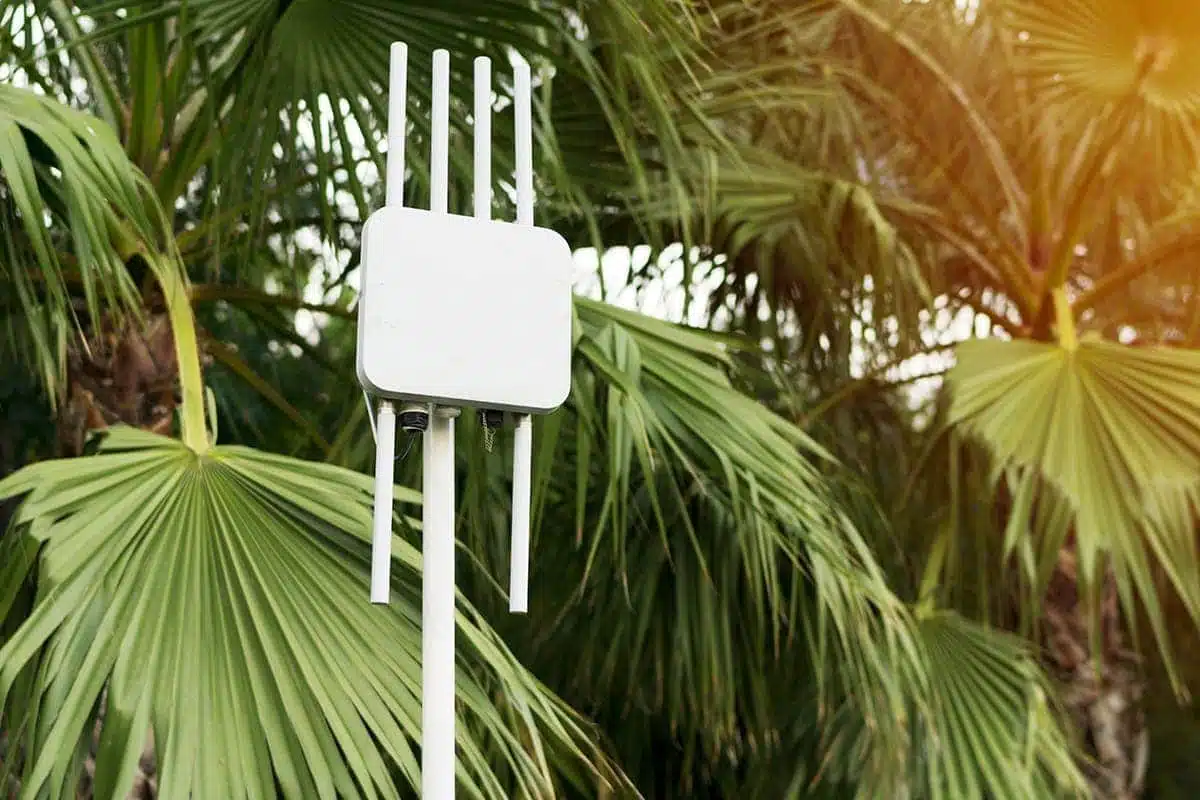
This guide explores the key factors essential for successful antenna integration, offering a framework for engineers and purchasing managers to make informed decisions. We will discuss four important considerations to guide your antenna selection: 1) intended use and environmental factors, 2) compliance with wireless standards or the need for custom designs, 3) the crucial concept of impedance matching, and 4) understanding Voltage Standing Wave Ratio (VSWR) for improving system efficiency.
Performance
The first step in selecting an antenna is to accurately define where and how it will be used. This includes more than just whether the setting is indoor or outdoor; it also considers the specific operating environment, desired range, and essential signal strength requirements.
In addition to the basic distinction between internal and external environments, it’s important to consider the specific characteristics of the setting where the device will be used. Will it operate in an industrial environment with a lot of metal or interference? Will it be exposed to extreme temperatures or humidity? These environmental factors can greatly affect antenna performance and should be taken into account during your selection process. For more complex environments or to ensure optimal performance, our Engineering Services team can offer valuable insights and support.
Wireless Standard or Custom Build?
The landscape of wireless communication is shaped by numerous established standards, each operating within specific frequency ranges and designed for particular applications. Utilizing these standards streamlines the design process and ensures compatibility. However, there are situations where a custom antenna solution is required.
Suntsu provides a diverse selection of antennas that comply with various wireless standards, as outlined in the table below. This extensive range enables engineers to easily identify components that align with their project specifications.
Frequency Range (MHz) Chip PCB Indoor Outdoor Patch NFC Applications 13.4 - - - - - x NFC (Near Field Communications) 13.56 - - - - - x NFC (Near Field Communications) 14.23 - - - - - x NFC (Near Field Communications) 433 x x - - - - ISM 433.05-434.79 x - - - - - ISM 450 x - - - - - ISM 470 x - - - - - ISM 863-870 x x - - - - ISM 902-928 x x - - - - ISM 698-798 x x x x - - LTE Full Band (GSM/3G/2G) 704-960 - - x x - - LTE Full Band (GSM/3G/2G) 824-960 x x - x - - LTE Full Band (GSM/3G/2G) 1427.9-1575.42 - - x x - - LTE Full Band (GSM/3G/2G) 1710-2170 x x x x - - LTE Full Band (GSM/3G/2G) 1710-2690 - - x x - - LTE Full Band (GSM/3G/2G) 2300-2400 x x - x - - LTE Full Band (GSM/3G/2G) 2490-2690 x x x x - - LTE Full Band (GSM/3G/2G) 1575.42 x - - x x - GPS/Glonass 1598-1606 x - - - x - GPS/Glonass 824-960 x x - x - - GSM/3G 880-960 - - - x - - GSM/3G 1710-2170 x x - x - - GSM/3G 1880-1930 x - - - - - DECT 2400 - - - x - - WiFi/Bluetooth/HDMI/Dual Band 2400-2500 x x x x - - WiFi/Bluetooth/HDMI/Dual Band 4900-5900 - x - - - - WiFi/Bluetooth/HDMI/Dual Band 5000 - - - x - - WiFi/Bluetooth/HDMI/Dual Band 5150-5850 x - x - - - WiFi/Bluetooth/HDMI/Dual Band 5150-5900 - x - - - - WiFi/Bluetooth/HDMI/Dual Band
If you have unique applications or specific performance requirements that off-the-shelf antennas can’t satisfy, our expert Engineering Design Services team is here to help with custom designs. We can optimize existing antenna designs or create entirely new components tailored to your exact needs. Whether you need a specialized form factor, a unique radiation pattern, or a component for an unusual frequency, Suntsu’s engineering expertise can help bring your vision to life.
Impedance Matching
Impedance matching is a vital factor in ensuring efficient power transfer within any RF (radio frequency) system. When the impedance of all interconnected components is matched, it allows for maximum power delivery from the source to the load and minimizes signal reflection.
In a wireless system, this means that the antenna, RF cable, and connectors must all have matching impedance levels, typically 50 ohms for most RF applications. If these impedances are mismatched, a portion of the signal power will reflect back towards the source, resulting in signal loss, reduced efficiency, and potential damage to components.
Consider the common configurations:
- External Antenna Systems: An external antenna system consists of the antenna, the RF cable connecting it, and the connectors at both ends. For optimal performance, the impedance of each component must be carefully matched.
Antenna + RF Cable + Connector = Matched Impedance
- PCB Antennas: When an antenna is directly integrated onto a printed circuit board (PCB), the main concern for impedance matching is the connection between the antenna and the rest of the circuit.
Antenna + Connector (to PCB traces) = Matched Impedance
- Chip Antennas: Chip antennas are small ceramic or metallic components that can be soldered onto a printed circuit board (PCB). In this case, the antenna becomes an integral part of the board design, and achieving proper impedance matching largely relies on the layout of the surrounding PCB and the matching network.
N/A (soldered directly on the board, matching handled by PCB design)
Achieving proper impedance matching typically requires the use of matching networks. These circuits are specifically designed to adjust the impedance of one component so that it aligns with another. Our Circuit Board Analysis service can help identify and correct any impedance mismatches on your PCBs, ensuring optimal signal integrity and power transfer.
VSWR
VSWR, or Voltage Standing Wave Radio, is a key measurement of efficiency in a radio frequency (RF) system. It indicates how effectively power is transmitted from a power source, such as a radio transmitter, to a load, like an antenna. In simple terms, VSWR shows how much of the forward power is absorbed by the load compared to how much is reflected back due to impedance mismatches [2].
The VSWR is calculated as the ratio of the maximum voltage (V_MAX) to the minimum voltage (V_MIN) in the standing wave pattern formed on the transmission line.
VSWR = V_MAX/V_MIN
A perfect match in an RF system occurs when all the power is transferred to the load without any power being reflected, resulting in a Voltage Standing Wave Ratio (VSWR) of 1:1. In practical applications, a VSWR close to 1:1, such as 1.5:1 or lower, is generally considered excellent. A lower VSWR indicates more efficient power distribution throughout the system, signifying less reflected power and better overall performance.

A Holistic Approach to Antenna Selection
Selecting the right antenna and ensuring its proper integration involves understanding technical specifications and considering the broader context of design, manufacturing, and the supply chain.
- Beyond the Initial Design: After successful prototyping, manufacturability review services can optimize antenna integration for mass production, addressing potential issues before they become expensive.
- Navigating Obsolescence: Antennas, like other electronic components, can become outdated. Suntsu’s obsolescence management expertise ensures you have strategies to find suitable alternatives and minimize disruptions when components reach their end of life.
- Managing Your Inventory: For OEMs and CMs, efficient inventory management solutions are essential for ensuring timely availability of antennas and other components. This may include vendor-managed inventory programs, providing complete visibility and control over your stock.

- The Advantage of a Trusted Partner: Partnering with an independent distributor such as Suntsu offers access to an extensive network of suppliers and a wide variety of antennas from leading brands. This global sourcing capability is crucial for overcoming supply chain challenges and obtaining even the hardest-to-find components.
By considering all these factors and leveraging the expertise of a trusted partner, you can ensure that your wireless designs achieve their full potential, delivering reliable and high-performance connectivity in an increasingly interconnected world.
Ready to elevate your wireless product designs with expertly matched antennas and a seamless supply chain? Contact Suntsu today for a personalized quote and let our team of experts help you find the perfect antenna solution for your next project.
FAQs
No, simply matching the size is not enough. Antennas are designed to operate optimally within specific frequency ranges and for particular applications (e.g., Wi-Fi, Bluetooth, cellular, GPS). Using an antenna outside its intended frequency range will result in poor performance due to significant impedance mismatches and inefficient radiation. It’s crucial to select an antenna that is specifically designed for your application’s frequency band.
A custom antenna is one that is designed and manufactured specifically for a unique application or to meet particular performance requirements that cannot be fulfilled by off-the-shelf solutions. You might need a custom antenna if your device has:
- Unique form factor or space constraints: Where standard antennas won’t physically fit.
- Specialized radiation patterns: For highly directional communication or unusual coverage needs.
- Uncommon frequency bands: Outside the typical standard ranges.
- Extreme environmental conditions: Requiring specialized materials or robot construction.
Antenna gain is a measure of how effectively an antenna converts input power into radio waves in a specific direction, or how effectively it receives radio waves from a specific direction, compared to a theoretical isotropic antenna (which radiates equally in all directions). It does not amplify the signal itself, but rather focuses the existing signal energy into a narrower beam. Higher gain generally leads to increased wireless range in the favored direction, but often at the expense of coverage in other directions (a narrower beamwidth). It’s a trade-off between concentrated power and wider coverage.
Antenna polarization refers to the orientation of the electric field component of the electromagnetic wave radiated by an antenna. Common types include linear (horizontal or vertical), circular (righ-hand or left-hand), and elliptical. For optimal communication, the transmitting and receiving antennas should have the same polarization. A mismatch in polarization can lead to significant signal loss and degraded performance, especially over long distances or in environments with multipath interference.
The physical material (e.g. copper, silver, gold plating) and construction (e.g. thickness, geometry, surface finish) of an antenna significantly impact its performance. Factors include:
- Conductivity: Highly conductive materials like copper minimize resistive losses, improving efficiency.
- Dielectric properties: The materials surrounding the conductive elements (e.g. PCB substrate) influence the antenna’s electrical length and resonant frequency.
- Mechanical stability: Robust construction ensure the antenna maintains its intended shape and performance over time, especially in harsh environments.
- Manufacturing precision: Accurate dimensions are crucial for precise frequency tuning and impedance matching.
Related Content
References
[1] IDC forecast (via Cabling Installation & Maintenance). “IDC: 41.6 billion connected IoT devices to generate > 79ZB of data by 2025” Available at: https://www.cablinginstall.com/wireless-5g/article/14035174/idc-416-billion-connected-iot-devices-to-generate-79zb-of-data-by-2025
[2] Qorvo. “BAW vs. SAW RF Filters” Available at: https://www.qorvo.com/design-hub/technical-articles/baw-vs-saw-rf-filters
[3] Suntsu Electronics. “Guidelines to Follow When Purchasing Connectors for Your RF System Design” Available at: https://suntsu.com/blog/guidelines-to-follow-when-purchasing-connectors-for-your-rf-system-design/