
Hi-Fi audio, or high fidelity, is the reproduction of high-quality audio, typically sought out by audio enthusiasts. The term Hi-Fi dates back to the 1950’s when it was used to describe audio reproduction that most closely replicated that of listening to a live performance. Through the years, other advancements like CDs and compressed digital audio files have continued to change how we listen to music.
Nowadays, audio IoT devices depend on Hi-Fi audio to ensure they operate correctly and provide the best user experience. Think of an Amazon Echo and the Hi-Fi audio used to talk to Alexa and answer questions or have her play your favorite songs. Processors like the NXP i.MX 8M Mini and AMLogic A113X2 have been popularly used in IoT audio applications but they require ultra-low jitter performance. In audio clocking, phase jitter — measured here across a 12 kHz to 5 MHz integration band — directly sets the noise floor a DAC can achieve, which is why a 43 fs figure matters for high-fidelity reproduction [2].
Suntsu’s Hi-Fi Audio CMOS Oscillators
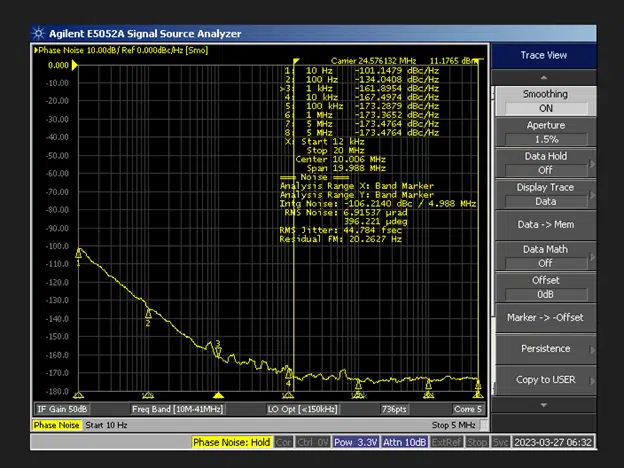
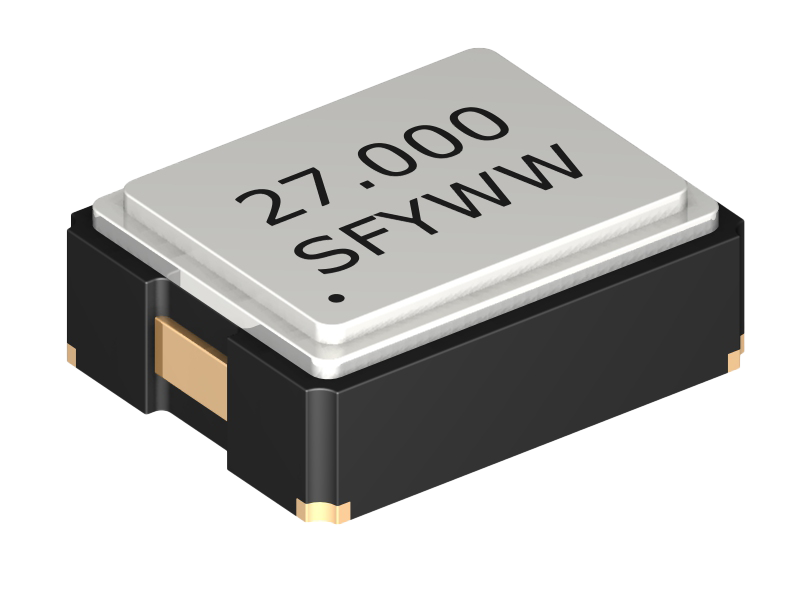
To meet jitter performance requirements, Suntsu has released ultra-low jitter CMOS oscillators with small form factors. The SUO32C series comes in a 3.2mm x 2.5mm package, and the SUO22C series is a 2.5mm x 2.0mm package size. For these crystal oscillators, the phase jitter (12kHz~5MHz) is 43fs and the phase noise plot shows -167dBc/Hz at 10kHz and -173dBc/Hz at 100kHz.
This performance is required for the PI2AES 2.0, a professional studio-grade audio I/O shield designed as a plug-and-play option, compatible with Raspberry Pi media players and other multimedia platforms. The PI2AES selects between a 22.5792 MHz clock for 44.1/88.2/176.4 kHz audio and a 24.576 MHz clock for 48/96/192 kHz audio, which is why an oscillator series intended to drive it must offer both frequencies [1]. Skyworks has a few options for network synchronizers, jitter attenuators, and clock generators, series Si55xx, Si540x, Si536x, which have been used in 5G network equipment applications. In 5G equipment these jitter attenuators and clock generators maintain the tight synchronization and holdover the network requires, and their performance depends on the quality of the reference clock feeding them [3]. Suntsu’s new series of CMOS oscillators meet phase requirements for these Skyworks products and can be used as the clock source.
CMOS Hi-Fi Audio Series
Key Features
- Ultra-low jitter performance
- Phase jitter (12kHz~5MHz) of 43fs
- Phase noise -167dBc/Hz at 10kHz, -173dBc/Hz at 100kHz
- Small form factor
- 22.5792MHz, 24.576MHz, 24MHz, 48MHz, and 54MHz including the two standard audio master clocks — 22.5792 MHz for the 44.1 kHz family and 24.576 MHz for the 48 kHz family [4].
- Compatible with:
- NXP I.MX8M Mini and AMLogic A113X2
- PI2AES 2.0
- Skyworks’ Si55xx, Si540x, Si536x series
Applications
- Hi-Fi Audio
- Pro Audio
- 5G network equipment
Interested in learning more about the SUO22C and SUO32C series?
Reach out to one of our engineering experts to see how these CMOS oscillators can fit into your next design.
References
[1] Pi 2 Design. “PI2AES Digital Pro Audio Hat Hardware Reference Manual” Available at: http://www.pi2design.com/uploads/4/8/5/3/48531975/pi2aes_hw_ref_manual_p3_4.pdf
[2] SiTime. “AN10007: Clock Jitter Definitions and Measurement Methods” Available at: https://www.sitime.com/support/resource-library/application-notes/an10007-clock-jitter-definitions-and-measurement-methods
[3] Skyworks. “AN1307: Holdover in 5G Networks Using IEEE 1588” Available at: https://www.skyworksinc.com/-/media/Skyworks/SL/documents/public/application-notes/an1307-holdover-in-5g-networks-using-ieee-1588.pdf
[4] TI E2E. “Generating 48KHz and 44.1KHz for DIT” Available at: https://e2e.ti.com/support/processors-group/processors/f/processors-forum/237495/generating-48khz-and-44-1khz-for-dit