
LDO vs. Switching Regulator
When choosing a voltage regulator, the initial decision is typically between a Linear Regulator (often a Low Dropout or LDO) and a Switching Regulator. Both are designed to keep voltage steady despite variations in input or load, but they do so using fundamentally different methods.
Low Dropout Regulator (LDO)
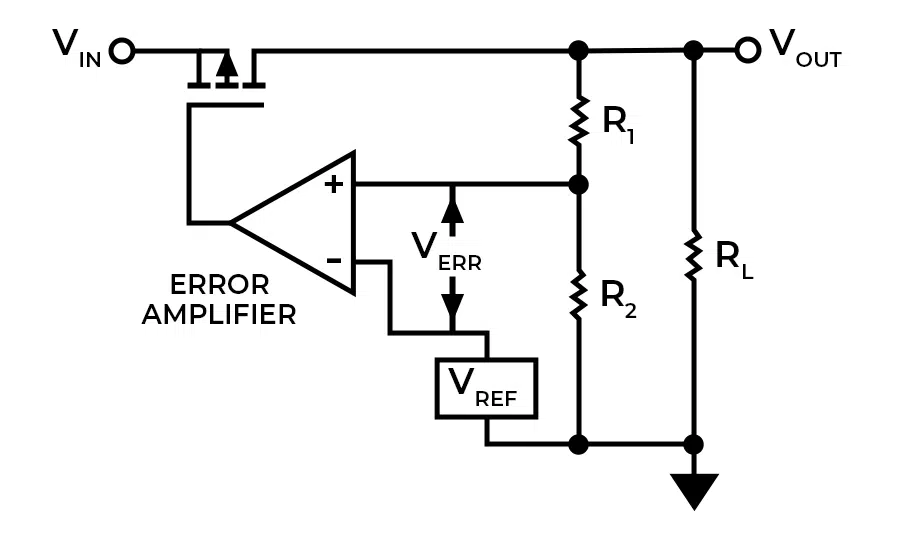
LDOs work by converting surplus power into heat. They act as variable resistors that precisely adjust to keep a stable output.
- Pros: LDOs operate silently, without switching on and off, so they produce minimal electromagnetic interference (EMI) or ripple. This makes them perfect for noise-sensitive tasks like powering precision analog sensors, audio devices, or RF and wireless modules. They are also easy to use, usually needing just an input and output capacitor.
- Cons: The main drawback is efficiency. Since they dissipate the voltage difference as heat, they tend to be inefficient when the gap between input voltage (Vin) and output voltage (Vout) is significant.
Switching Regulator
Switching regulators, such as buck, boost, or buck-boost converters, quickly turn a series component on and off, utilizing an inductor and capacitor to stabilize the output. DC-DC switching controllers use this same buck, boost, and buck-boost approach, but manage external switching elements like MOSFETs or transistors for greater design flexibility.
- Pros: High efficiency characterizes the switching regulator, often surpassing 90% efficiency even in significant voltage reductions. This is vital for high-power applications or devices sensitive to heat dissipation.
- Cons: The switching action produces noise (EMI) and output ripple. Although modern power management ICs operate at high switching frequencies to shift this noise away from sensitive bands, effective filtering and PCB layout are still essential.
Critical Specifications
After choosing your topology, proceed to review the specifications. Although the current rating and output voltage are clear, several subtle details can significantly impact your design.

This specification explains the origin of the term "Low Dropout" in LDO. It describes the smallest differential voltage between input and output necessary for the regulator to keep functioning properly.
- Why it matters: This is essential for applications powered by batteries. As a battery discharges, its voltage decreases. A regulator with a lower dropout voltage lets you use more of the battery's remaining capacity before the system turns off. For instance, regulating a 3.7V Li-Ion battery down to 3.3V leaves just 400mV of headroom. While a typical linear regulator might shut down, a high-performance LDO will continue functioning.
- For long-life portable electronics, it is essential to combine a low-dropout regulator with high-performance energy storage. Discover more about various storage solutions in our blog: Powering IOT: Nichicon Introduces High-Performance LTO Batteries.
Dropout is what determines how much of a battery's remaining capacity a regulator can use before falling out of regulation [2].
Quiescent current is the current drawn by the regulator itself when it is enabled but carrying zero load.
- Why it matters: Devices that operate mostly in "sleep" or standby mode, such as remote IoT sensors, can experience battery drain due to high quiescent current even when inactive. For applications with intermittent duty cycles, it is important to select power management ICs with ultra-low quiescent current (Iq).
- To learn more about optimizing designs for intelligent, low-power edge devices, see our insights in: Have you considered using Edge AI in your product designs?
Should you select a fixed voltage option (such as 3.3V or 5V) or opt for an adjustable version that employs an external resistor divider??
- Fixed: Easier to operate, demands fewer external parts, and conserves board space.
- Adjustable: Provides efficiency tuning and flexible voltage regulation. Stocking a single adjustable regulator that supports five different voltage rails across your product line is a smart inventory approach from a supply chain perspective.
- If you want to streamline your parts list to cut costs and make procurement easier, our team offers expert BOM Analysis and Cost Reduction services.
Best Practices for Implementation
Choosing the component is just the first step; correct implementation is key to its success in the real world.
Thermal Management
Heat poses a threat to reliability. For linear regulators, power dissipation is given by Pd = (Vin – Vout) x Iout. Even a slight voltage drop under high current conditions can produce a substantial amount of heat.
- Solution: Make sure your PCB layout features sufficient copper pours connected to the regulator’s thermal pad to serve as a heat sink. If the thermal load exceeds the package’s capacity, consider switching to a switching regulator or choosing a larger package type. If thermal simulations or layout design challenges arise, our Engineering Design Services are available to help optimize your board.
Capacitor Selection
Voltage regulators rely on input and output capacitors for loop stability and transient response.
- The Trap: Not all capacitors are created equal. An LDO datasheet might specify a 10μF ceramic capacitor, but if you ignore the capacitor’s ESR (Equivalent Series Resistance) or voltage derating, the regulator may oscillate. Output-capacitor ESR and value directly affect both loop stability and PSRR, which is why the datasheet’s stability requirements matter as much as the nominal capacitance [3].
- The Fix: Always verify the dielectric type (X7R or X5R are usually preferred for power rails) and voltage rating. You can browse our extensive inventory of Capacitors to find the exact match for your regulator’s stability requirements.

Ready to secure your supply chain? Contact Suntsu today to source the perfect voltage regulator or find in-stock alternatives for your critical power rails.
FAQs
Power Supply Rejection Ratio (PSRR) measures how well a voltage regulator rejects ripple and noise from the input power supply. While our guide mentions that LDOs are “quiet,” PSRR is the specific metric on the datasheet that quantifies this capability (usually expressed in decibels). High PSRR is crucial for RF and audio applications where input noise could degrade signal quality.
While they look similar, a voltage regulator is designed to deliver current to a load at a fixed voltage. A voltage reference is designed to provide a precise, stable voltage with very little current, used primarily as a reference point for A/D converters or other regulators. You generally cannot power a circuit with a voltage reference.
Line regulation measures the regulator’s ability to maintain a constant output voltage despite changes in the input voltage (e.g., as a battery drains). Load regulation measures the ability to maintain a constant output voltage despite changes in the output load current (e.g., when a processor wakes up from sleep). Both specs are critical for ensuring stability in dynamic environments.
If the output voltage becomes higher than the input voltage (e.g., if the input power is cut but a large output capacitor is still charged), current can flow backward through the regulator and damage it. To prevent this, designers often place a protection diode across the regulator (anode at Output, cathode at Input) to provide a safe path for the discharge current.
Soft start is a feature that gradually ramps up the output voltage when the device is first turned on. This prevents a massive in-rush of current that could trip upstream fuses or cause voltage dips on the main power rail. It is highly recommended for applications with large capacitive loads or sensitive upstream power sources.
Related Content
References
[1] Texas Instruments. “Linear & LDO Regulators” Available at: https://www.ti.com/product-category/power-management/linear-ldo-regulators/overview.html
[2] Texas Instruments. “Low Dropout Regulators Quick Reference Guide” Available at: https://www.ti.com/lit/sg/slyt228p/slyt228p.pdf
[3] Texas Instruments. “Understanding the Terms and Definitions of LDO Voltage Regulators” Available at: https://www.ti.com/lit/an/slva079/slva079.pdf